Start here
How to Play Poople
This Poople how-to-play guide explains the four-letter word ladder: start with the daily word, change one letter at a time, and reach POOP. Every intermediate word must be a real word.
How to play Poople: the rule in one line
Change exactly one letter each move; every word must be four letters and valid; the target is POOP.
Start with today's word
Everyone gets the same starting word. In Unlimited, the start is random.
Enter a four-letter word
It must be a real word and differ by exactly one letter from the previous word.
Reach POOP
Keep going until you reach POOP. A longer valid route still solves the puzzle.
Compare par
Par is the shortest route found. Fewer moves is better, but the route must be valid.
Worked example
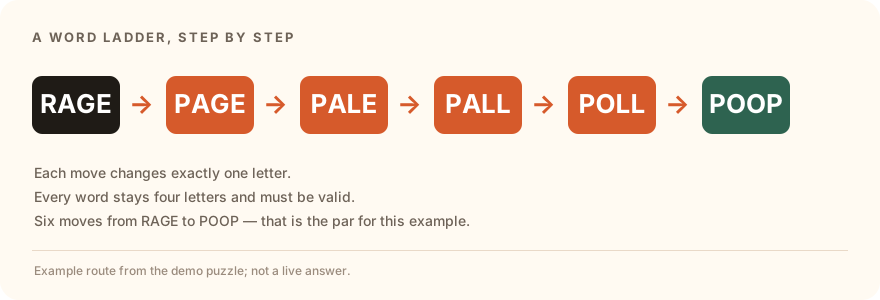
A sample route:
RAGE
PAGE
PALE
PALL
POLL
POOL
POOP
Each line changes one letter from the line above. Check: RAGE→PAGE changes R/P; PAGE→PALE changes G/L; and so on.
Common mistakes
- Changing two letters at once.
- Using a proper noun or a word the game does not accept.
- Forgetting that the target is POOP, not any four-letter word.
- Copying a route without checking each step.
How to play Poople: How to play Poople: Daily vs Unlimited
Same rule, different starting point.
| Mode | Start | When to use it | Link |
|---|---|---|---|
| Daily | Official daily word | Play today's shared puzzle | Play daily |
| Unlimited | Random start | Practice more, no daily wait | Play Free Unlimited |
| Hints | Today's puzzle | Stuck but still want to solve | Open hints |
| Solver | Your current word | Already mid-ladder | Open solver |
What is a word ladder, exactly?
Poople is a four-letter word ladder. You start with one word and reach POOP by changing exactly one letter at a time. Every word on the ladder has to be a real, accepted four-letter word.
The rule is small. The decisions are not.
A legal move is easy to describe: keep four letters, change one, and make sure the result is a word the game accepts. The hard part is choosing a move that still has a future. A word can be legal and still be a dead end.
That is why strong players talk about “bridge words.” A bridge word connects the word you have to a word you need later. If you only look one move ahead, you can end up circling the same three words while the puzzle gets further away.
When you are stuck, do not just try random four-letter words. Pick one position — first, second, third or fourth letter — and ask which replacement creates a word with another exit. That single habit solves more puzzles than memorizing word lists.
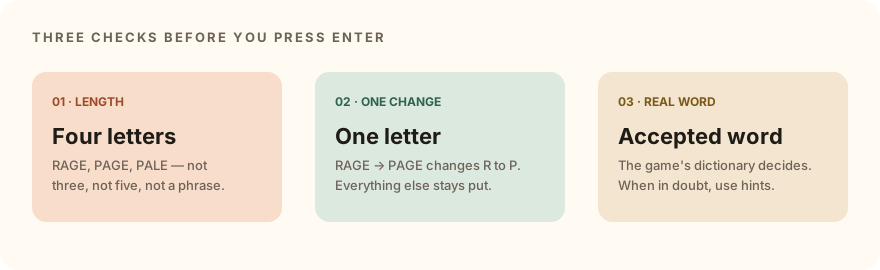
The three checks before you press Enter.
Most rejected moves fail one of these. Check them in order.
Why a real word can still be rejected
Every word game has a dictionary. Poople's dictionary is not the same as a general English dictionary, a Scrabble dictionary or the dictionary inside another daily game. A word can be common, correct English and still be outside the accepted list.
This is the single most common complaint from new players: “the word is valid, why did it reject me?” The honest answer is that validity is defined by the game, not by your vocabulary. When a move is rejected, try a different word with the same letter change instead of assuming the puzzle is broken.
Our rules page cannot publish the game's entire private dictionary. What we can do is keep the official route as the primary answer, mark any practice route that uses a different dictionary, and avoid pretending an unverified word is official.
Par, route and the shortest path.
Three terms that sound similar but answer different questions.
| Term | What it means | Why it matters |
|---|---|---|
| Route | The actual sequence of words from start to POOP. | Any legal route solves the puzzle. |
| Par | The number of moves in the shortest known route. | It is the score to compare against, not a requirement. |
| Shortest path | A route with the fewest moves found by a solver. | Useful after you solve, or when you want a target. |
A longer route is still a valid solve. Do not throw away a working path because it is not par. If you are learning, finishing the ladder matters more than matching the shortest route.
Common player problems, answered.
These are the situations that send players to search, Reddit or a solver.
Check the dictionary, not your spelling. Try another word with the same one-letter change; the route can still be valid even if your first choice is rejected.
Work position by position. Change the first letter, then the second, and so on. Say the four possible patterns out loud; do not scan the whole dictionary at once.
You may be on a dead-end branch. Use hint level 1 or open the solver from your current word; it can show a next step without restarting.
The archive has every closed puzzle. Today's puzzle is separate; the archive keeps finished puzzles stable.
Open Unlimited. Random starts, no daily wait, same rule.
A 10-minute practice plan.
If you want to get better at the daily, practice the skill instead of memorizing answers.
Minute 1–2: read the start
Write down the start word and the target. Say which letters could change without creating a plural or a proper noun.
Minute 3–5: find two bridges
Look for two different next words, not one. If one branch dies, you have another.
Minute 6–8: work backward from POOP
POOP has few useful neighbors. Sometimes the fastest path is to find a word one letter away from POOP and connect to it.
Minute 9–10: review
Compare your route with the answer. Count moves, not words. Ask which move you would change next time.
FAQ
Short answers to the first questions new players ask.
Is Poople free?
Yes. The daily game, Free Unlimited practice, archive, hints and solver are free. There is no paywall.
Do I need an account?
No. The site works without an account.
Why is a word rejected?
The word must be four letters, valid in the game's dictionary, and one letter different from the previous word.
Can I play older puzzles?
Yes. The archive lists every closed puzzle with its starting word and route.
Why word ladders feel harder than they look.
The rule is one sentence. The search space is not.
At every step you have four letter positions, but each position can produce many words. Most of them are legal; few of them are useful. The hard part is not remembering the rule, it is filtering candidates quickly enough to see a route.
This is why experienced players talk about “seeing” the ladder rather than “knowing” more words. They are not scanning the dictionary; they are narrowing the four positions and checking exits. That is a learnable skill, and it is what the examples on this page are meant to show.